
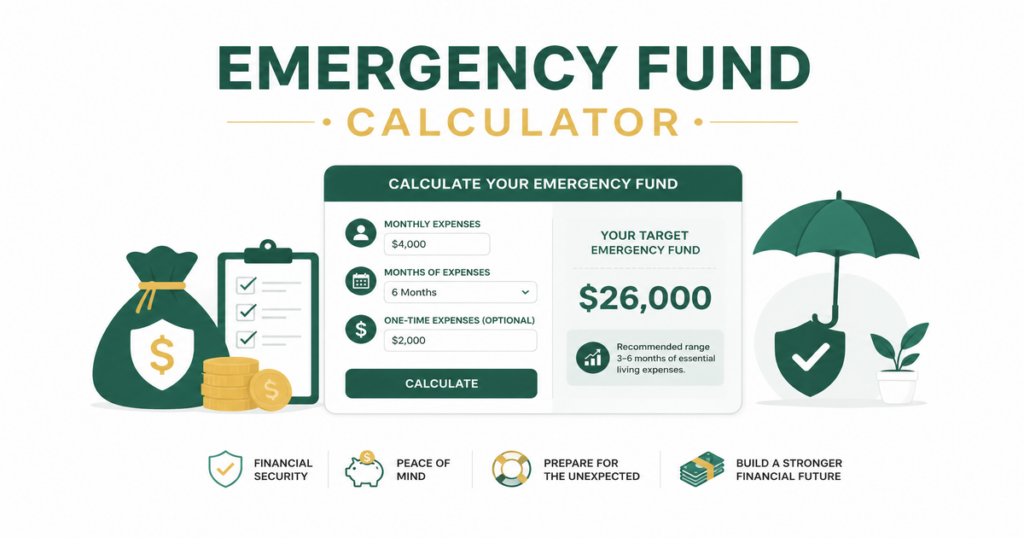
Emergency Fund Calculator
Estimate how much to keep aside for job loss, medical bills, or urgent repairs. Uses essential monthly expenses × months of coverage.
Use the calculator above to estimate your target emergency fund in rupees. Enter only essential monthly expenses—not your full salary or lifestyle spending—then choose how many months of coverage you want (typically 3–6). If you already have some savings set aside, add that too; the tool shows how much you still need and, if you enter a monthly savings amount, roughly how long it will take to reach your goal.
What is an emergency fund?
An emergency fund is cash you can access within 24–48 hours when life disrupts your income or budget: job loss, medical bills, urgent home repairs, or family travel for a crisis. It is not for vacations, phone upgrades, festival shopping, or investing when markets dip.
Without a buffer, every surprise becomes credit card debt at 36–42% APR or a forced mutual fund redemption during a market correction. Building an emergency fund first protects your long-term investments and gives you room to negotiate at work without panic.
How this calculator works
The formula is straightforward:
Target emergency fund = Monthly essential expenses × Months of coverage
Amount still needed = Target − Already saved
If you enter a monthly savings amount toward the fund, the calculator also estimates:
Months to reach target = Amount still needed ÷ Monthly savings (rounded up)
What counts as “essential” expenses?
- Rent or home EMI
- Groceries and cooking gas
- Utilities (electricity, water, internet needed for work)
- Transport to work
- Insurance premiums and minimum debt payments
- School fees (if applicable)
Exclude dining out, OTT subscriptions, discretionary shopping, and SIPs—in a true emergency you can pause investing temporarily.
Worked example (India)
Suppose your essential monthly expenses total ₹40,000 and you want 6 months of coverage:
- Target fund = ₹40,000 × 6 = ₹2,40,000
- You already have ₹60,000 in a savings account → still need ₹1,80,000
- Saving ₹5,000/month toward the fund → about 36 months to close the gap
Many households aim for a smaller starter fund (₹50,000–₹1,00,000) first, then build to the full target over 12–24 months while continuing minimum debt payments and basic SIPs if cash flow allows.
How many months should you cover?
| Profile | Suggested months |
|---|---|
| Stable salaried job, dual income | 3 months |
| Single income household | 4–5 months |
| Commission or variable pay | 5–6 months |
| Self-employed or freelancer | 6–12 months |
Where to keep emergency money in India
Emergency money must be liquid and low risk. Common options:
- Savings account — instant access; keep a portion here for true emergencies.
- Liquid mutual funds — T+1 redemption; often slightly better returns than savings accounts. Check exit load and minimum balance rules.
- Fixed deposits — use for the portion you are unlikely to need within 30 days; choose flexible or sweep FDs if your bank offers them.
Do not park emergency funds in equity mutual funds, crypto, or long lock-in products like tax-saving ELSS.
Common mistakes to avoid
- Using gross salary instead of essential expenses — inflates the target unrealistically.
- Counting investments as emergency money — they can drop 20–40% exactly when you need cash.
- Never replenishing after use — treat the fund like insurance; refill after every withdrawal.
- Keeping everything in one illiquid FD with penalty on early break.
Frequently asked questions
Should I build an emergency fund before investing?
Yes—at minimum a starter fund (one month of essentials or ₹50,000, whichever is higher) before aggressive equity SIPs. High-interest debt should usually be tackled alongside or before large investing; see our guide on how to start investing.
Is ₹1 lakh enough for an emergency fund?
It depends on your expenses. For someone with ₹25,000/month in essentials, ₹1 lakh covers 4 months—reasonable. For ₹80,000/month essentials, ₹1 lakh is only 1.25 months. Always run your own numbers in the calculator above.
Does an emergency fund earn good returns?
No—and that is intentional. The job of this money is stability, not growth. Returns come from your long-term portfolio after the buffer is in place.
Related reading
- Emergency fund guide for India — full pillar on how much, where to keep it, and when to use it
- 50/30/20 budget rule explained — fit emergency savings into your monthly plan
- Debt payoff calculator — if high-interest debt is blocking your savings
Disclaimer: This calculator and article are for education only—not personalized financial advice. Verify current account rates and product rules before acting.