
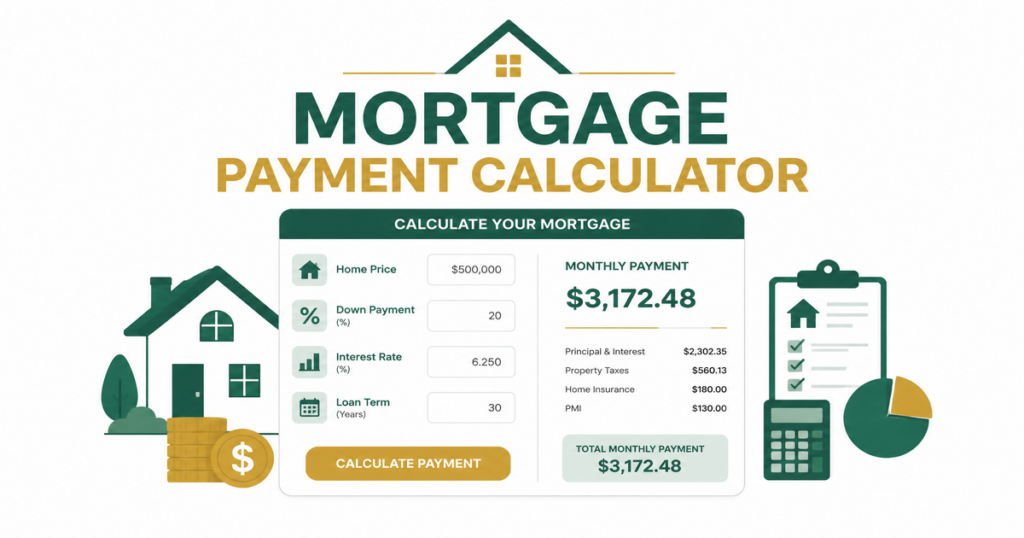
Mortgage / Home Loan EMI Calculator
Estimate monthly EMI for a home loan. Formula: standard reducing-balance amortization.
Use the calculator above to estimate your monthly home loan EMI in rupees. Enter the loan amount (principal), annual interest rate, and tenure in years. The tool shows your monthly EMI, total amount paid over the full tenure, and total interest cost—so you can compare offers and plan affordability before signing loan documents.
What is a home loan EMI?
EMI (Equated Monthly Installment) is the fixed amount you pay each month toward a home loan. Each EMI splits into interest on the outstanding balance and principal repayment. Early in the loan, interest forms the larger share; over time, principal repayment grows.
Banks in India typically offer floating or fixed rates on home loans. Even a 0.25% rate difference on a ₹50 lakh loan can change total interest by lakhs of rupees over 20 years—worth modeling before you commit.
How this calculator works
The calculator uses the standard reducing-balance amortization formula:
EMI = P × r × (1 + r)n ÷ ((1 + r)n − 1)
Where:
- P = loan principal (amount borrowed)
- r = monthly interest rate (annual rate ÷ 12 ÷ 100)
- n = total number of monthly installments (years × 12)
Total payment = EMI × n
Total interest = Total payment − P
Worked example (India)
Loan amount: ₹50,00,000 | Rate: 8.5% p.a. | Tenure: 20 years (240 months)
- Monthly EMI ≈ ₹43,391
- Total payment ≈ ₹1,04,13,840
- Total interest ≈ ₹54,13,840 — more than the original loan
Try shortening tenure to 15 years in the calculator: EMI rises but total interest drops significantly. That trade-off is central to home-buying decisions.
How much home loan can you afford?
Banks often cap EMI at 40–50% of net monthly income, but a safer personal rule is 30–35% of take-home pay—including existing EMIs, insurance, and maintenance.
- Add estimated maintenance, property tax, and society charges (often ₹3,000–₹8,000/month in metros).
- Keep an emergency fund separate from your down payment—do not zero out savings to buy.
- Stress-test at +1% interest rate if you choose floating loans—rates can rise over a 20-year tenure.
Factors that affect your EMI
| Factor | Effect on EMI |
|---|---|
| Higher loan amount | EMI increases |
| Higher interest rate | EMI increases; total interest rises sharply |
| Longer tenure | Lower EMI but much higher total interest |
| Larger down payment | Lower principal → lower EMI and interest |
| Prepayment of principal | Reduces future interest; may shorten tenure |
Prepayment and balance transfer
Most floating-rate home loans allow partial prepayment without penalty. Even one extra EMI per year can shave months or years off tenure. A balance transfer to another bank at a lower rate can help if the savings exceed processing fees and legal costs—recalculate EMI before switching.
This calculator shows the baseline schedule. For prepayment scenarios, adjust tenure or principal manually and recalculate, or ask your lender for an amortization schedule with prepayment applied.
Frequently asked questions
Does EMI include insurance or registration costs?
No. This calculator covers principal and interest only. Stamp duty, registration, GST on under-construction property, and home insurance are separate upfront or annual costs.
Fixed vs floating rate — which is better?
Floating rates track market benchmarks (repo-linked) and can fall or rise. Fixed rates offer certainty for a initial period but may reset later. Compare total cost under both scenarios if your bank offers a choice.
Is tax benefit included?
No. Section 80C and 24(b) deductions on principal and interest can improve effective cost—but rules and limits change. Consult a tax professional for your slab and co-borrower structure.
Related reading
- Financial goals by age — home-buying milestones and retirement planning
- Emergency fund calculator — protect yourself beyond EMI capacity
- Compound interest calculator — long-term wealth after home purchase
Disclaimer: EMI estimates assume fixed rate and on-time payments. Lender fees, insurance, and rate resets are excluded. Educational content only—not loan or tax advice.